T-Mobile US arrived at Mobile World Congress 2026 in Barcelona with a clear message: the era of the connectivity “pipe” is over. The carrier used the world’s biggest telecom stage to announce a series of partnerships designed to push wireless networks from 5G-Advanced toward a fully intelligent, AI-native 6G future — and it brought some of the biggest names in tech along for the ride.
From a deepened alliance with Qualcomm to portable RAN trials with Ericsson and Nvidia, and a transatlantic research hub with Deutsche Telekom, T-Mobile laid out a roadmap that puts intelligence at the center of every network decision. Here is what each announcement means — and why it matters for the future of connectivity.
T-Mobile and Qualcomm Push the 6G Roadmap Forward
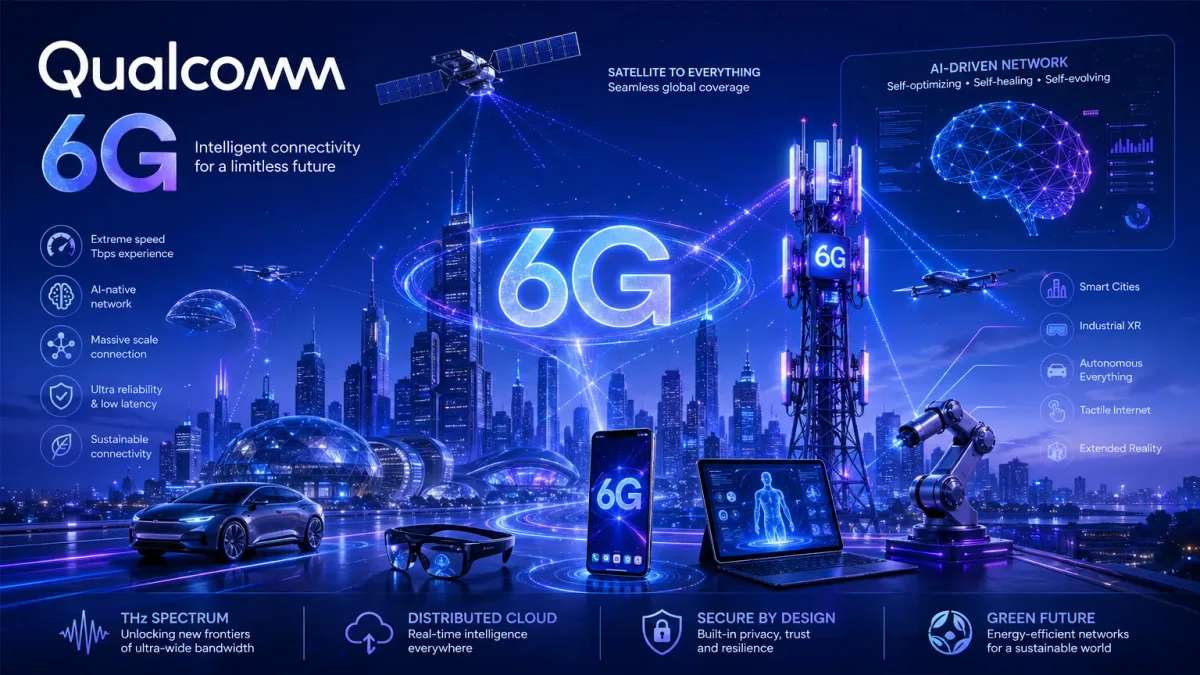
The most headline-grabbing news out of MWC came from T-Mobile and Qualcomm Technologies, who announced a deepened strategic collaboration to accelerate the industry transition from 5G-Advanced to 6G. rcrwireless The two companies share a long track record — together they helped define and scale 5G across the United States — and now they are channeling that history into shaping the architecture of next-generation wireless, with commercial 6G targeted as early as 2029.
T-Mobile US President of Technology and Chief Technology Officer John Saw put it directly: “Our expanded collaboration with Qualcomm Technologies allows us to help shape the foundational technologies of 6G from the outset, ensuring the next generation of wireless prioritizes efficiency, intelligence, performance, and real-world customer impact.”
The collaboration organizes its work around three core pillars. The first covers Advanced Connectivity — expanding coverage, capacity, uplink performance, and spectral efficiency. The second introduces Wide-Area Sensing, which embeds sensing capabilities natively into the network to enable real-time environmental awareness, digital twins, and traffic insights. The third targets Energy-Efficient High-Performance Compute, building distributed infrastructure that supports AI workloads across cloud and edge environments without burning unnecessary power.
Each pillar addresses a recognized gap in current 5G networks and signals where the industry needs to go before 6G deployments begin in earnest.
Portable AI RAN: Why Hardware Flexibility Changes Everything
T-Mobile and Ericsson also revealed successful trials of Ericsson Cloud RAN software running on Nvidia AI infrastructure — demonstrating a portable, hardware-agnostic RAN stack capable of operating across traditional Ericsson silicon or alternative compute platforms, including Commercial Off-The-Shelf systems enhanced with Nvidia acceleration. rcrwireless
Martten Lerner, head of network strategy and product management at Ericsson, explained the significance: “Cloud RAN software is portable by design. By running the same RAN software stack across multiple hardware platforms, we reinforce our commitment to providing mobile operators with true flexibility without compromising on high performance.”
For network operators, this matters enormously. The ability to run the same software on different hardware gives carriers real leverage over cost, vendor relationships, and deployment timelines. T-Mobile described the trial as a step in its evolution from a connectivity pipe to an intelligent platform — one capable of supporting not only traditional connectivity but future AI and 6G services. rcrwireless
The broader industry momentum behind this approach is hard to ignore. MWC 2026 hosted triple the AI-RAN innovation compared to the previous year, with 26 out of 33 AI-RAN Alliance demos built on Nvidia AI Aerial. On the show floor, T-Mobile ran concurrent AI and 5G workloads combining video streaming, generative inference, and AI-powered captioning live. Techloy
The Joint 6G Innovation Hub: Building Networks for the Physical World
Perhaps the most forward-looking announcement from T-Mobile at MWC was the launch of the Joint 6G Innovation Hub with Deutsche Telekom. Anchored by T-Mobile’s Innovation Lab in Bellevue, Washington, and Deutsche Telekom’s T-Labs in Berlin, the transatlantic initiative targets AI-native and autonomous network research across three interlinked priorities: building networks optimized for intelligent connectivity and secure wide-area sensing; integrating high-performance compute within network architectures; and advancing Physical AI — systems capable of interpreting, acting on, and interacting with the physical world in real time. rcrwireless
CTO Saw offered a sharp description of what Physical AI demands from a network: “Today’s AI systems are built around informational tokens, data that describes or predicts. Physical AI is different. Data must carry intent, context, and timing to trigger real-world action — what we describe as operational kinetic tokens — requiring deterministic performance, ultra-low latency, and precise synchronization.”
That phrase — kinetic tokens — captures the fundamental challenge. Future networks must evolve beyond transporting bits to delivering deterministic outcomes tailored to real-world needs, from robotics and logistics to autonomous systems that rely on ultra-low latency, precise timing, and distributed intelligence. rcrwireless
The T-Mobile and Deutsche Telekom hub will use that vision as its design brief, building 6G architectures meant to handle those demands at global scale.
An Industry Inflection Point, Not Just a Trade Show
What made MWC 2026 different from previous years was the evidence. A cascade of announcements from the worlds biggest telecom vendors, chipmakers, and operators delivered field trial results, commercial product launches, open-source toolkits, and a multi-operator coalition committing to build 6G on AI-native foundations. Artificial Intelligence News
Nvidia secured commitments from more than a dozen global operators and technology companies — including BT Group, Deutsche Telekom, Ericsson, Nokia, SK Telecom, SoftBank, T-Mobile, Cisco, and Booz Allen — to build 6G on open, secure, and AI-native software-defined platforms. Techloy
According to Nvidias State of AI in Telecom report, 77% of respondents expect AI-native wireless architecture to deploy faster than any previous generation of networks. Artificial Intelligence News For consumers, businesses, and industries that depend on low-latency, high-reliability connectivity, the timeline is accelerating faster than most people realize.
4 Questions People Are Asking About MWC 2026 and AI-Native Networks
What did T-Mobile announce at MWC 2026? T-Mobile announced three major partnerships at MWC 2026. It deepened its 6G collaboration with Qualcomm, completed successful portable AI RAN trials with Ericsson and Nvidia, and launched a Joint 6G Innovation Hub with Deutsche Telekom. Each move signals T-Mobile’s push to lead the shift from standard 5G toward AI-native network infrastructure.
What is an AI-native network and why does it matter? An AI-native network embeds intelligence directly into its architecture — from the radio access layer to the core — rather than bolting it on afterward. It matters because these networks can self-optimize, reduce energy consumption, and support new use cases like real-time sensing, autonomous vehicles, and Physical AI applications that demand ultra-low latency and precise timing.
When will 6G networks launch commercially? T-Mobile and Qualcomm are targeting commercial 6G as early as 2029. The transition will build on 5G-Advanced infrastructure currently being refined. MWC 2026 confirmed that field trials are already underway, hardware is shipping, and major operators are forming coalitions to standardize 6G on AI-native foundations ahead of that launch window.
What is Physical AI and how does telecom support it? Physical AI refers to systems that perceive and respond to the real world in real time — think robotics, autonomous logistics, and smart infrastructure. Telecom networks support Physical AI by delivering what T-Mobile CTO John Saw calls “kinetic tokens”: data that carries intent, context, and timing precise enough to trigger real-world action. That requires deterministic performance and ultra-low latency that current networks are still building toward.