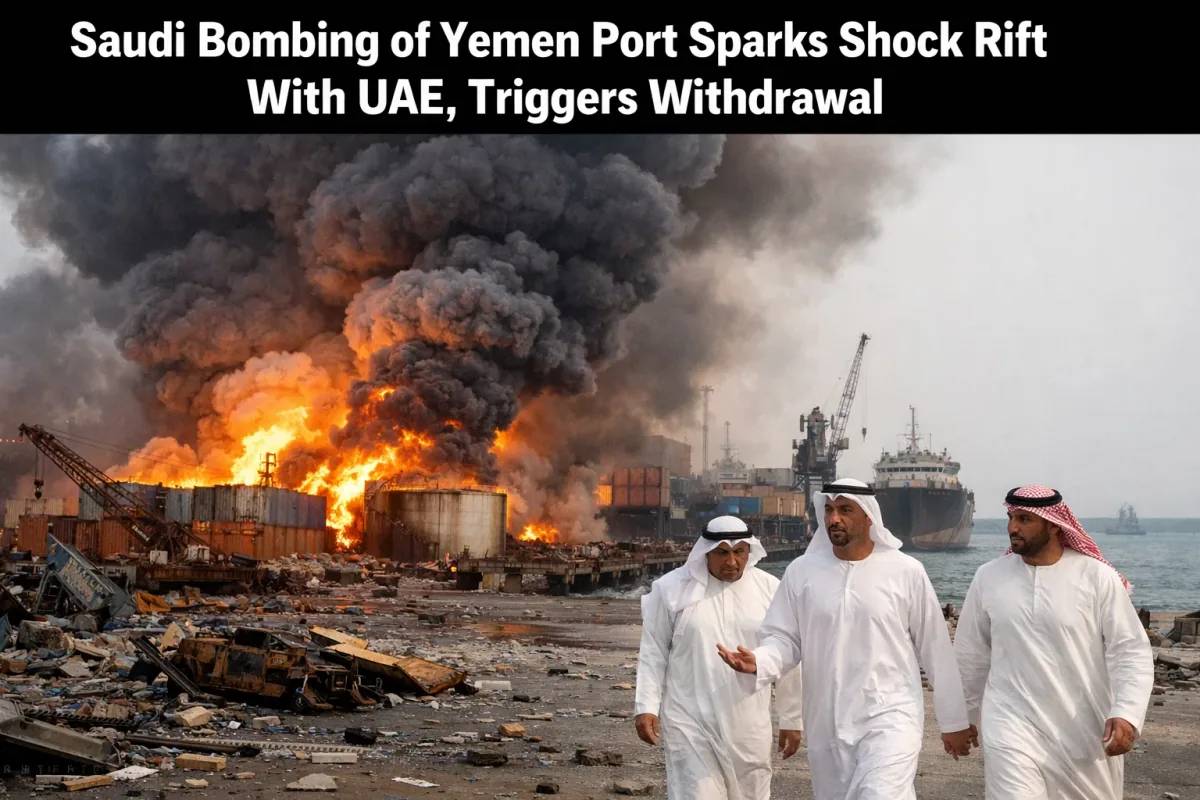
Saudi Arabia has revealed new details about a coalition airstrike on Yemen’s port city of Mukalla, a move that has sharply escalated tensions with Gulf ally the United Arab Emirates. The fallout has already triggered a dramatic response: the UAE announced it will withdraw its remaining forces from Yemen.
The developments expose deep fractures inside the Saudi-led coalition and reshape the balance of power in southern Yemen. Here’s what happened, why it matters, and what comes next.
Saudi Arabia releases images from Mukalla strike
Saudi coalition spokesman Major-General Turki al-Maliki presented images documenting the early Tuesday military operation at Mukalla port. He said coalition forces discovered two ships carrying more than 80 vehicles and containers filled with weapons and ammunition.
Al-Maliki stated that Emirati personnel transferred vehicles, containers, and staff to Yemen’s al-Rayyan military base without informing Saudi Arabia. He stressed that coalition forces followed the rules of engagement throughout the operation.
UAE announces withdrawal from Yemen
Hours after the strike, the UAE declared it would withdraw its forces from Yemen. Abu Dhabi said it would end what it described as “counterterrorism” operations following rising tensions with Saudi Arabia.
The announcement came after Yemen’s internationally recognised government demanded that UAE forces leave the country within 24 hours. Saudi Arabia publicly backed that demand.
Earlier the same day, Saudi-led coalition jets targeted Mukalla port, which Riyadh said hosted a UAE-linked weapons shipment destined for the Southern Transitional Council (STC).
Focus shifts to the Southern Transitional Council
The STC once fought alongside Yemen’s recognised government against the Houthi movement. This month, the group turned its weapons on Saudi-backed government forces and launched a major offensive to establish an independent southern state.
The STC seized large areas across southern Yemen, including Hadramout and Mahara provinces. Hadramout borders Saudi Arabia, while Mahara lies close to the Saudi frontier.
Saudi Arabia said it felt disappointed by what it described as UAE pressure on the STC to expand military operations in those regions. Riyadh warned that the moves directly threatened its national security.
Riyadh draws a red line
Saudi officials said any threat to national security remains a “red line.” The kingdom warned it would take all necessary steps to confront and neutralise such threats.
Following the fast-moving events, the UAE Ministry of Defence said it conducted a comprehensive review of its Yemen role. The ministry announced it would terminate the deployment of its remaining counterterrorism personnel to ensure their safety.
Gulf states move to calm tensions
Qatar’s Ministry of Foreign Affairs welcomed statements from both Saudi Arabia and the UAE. Doha said the remarks showed a commitment to regional stability, good neighbourliness, and the principles of the Gulf Cooperation Council charter.
Saudi Arabia, the UAE, Qatar, Bahrain, Kuwait, and Oman all belong to the GCC.
At the diplomatic level, Saudi Foreign Minister Prince Faisal bin Farhan held phone calls with US Secretary of State Marco Rubio and Pakistan’s Deputy Prime Minister and Foreign Minister Ishaq Dar to discuss regional developments.
Yemen’s leadership cuts defence ties with UAE
The Mukalla strike highlighted growing divisions inside the coalition formed in 2015 to fight Yemen’s Houthi rebels, who still control most of the north.
Emirati troops entered Yemen that year but withdrew most forces in 2019, leaving a limited presence in government-controlled southern areas.
After the airstrike, Rashad al-Alimi, head of Yemen’s Presidential Leadership Council, dissolved a defence pact with the UAE. He ordered Emirati forces to leave within 24 hours.
In a televised address, al-Alimi said officials had definitively confirmed that the UAE pressured and directed the STC to rebel against state authority through military escalation.
Saudi Arabia supported al-Alimi’s decision and urged the UAE to halt all military and financial support to Yemeni factions.
UAE rejects Saudi accusations
The UAE said the Saudi airstrike caught it by surprise. Abu Dhabi denied shipping weapons and said the cargo belonged to Emirati forces, not the STC.
The UAE stressed its commitment to Saudi Arabia’s security and said it sought a solution based on verified facts and existing coordination to prevent escalation.
Tensions rise as STC refuses to retreat
Yemeni state television showed black smoke rising from Mukalla port and burned vehicles following the strike. Al-Alimi imposed a 72-hour no-fly zone and ordered a sea and ground blockade on all ports and crossings.
The STC rejected calls to withdraw from newly seized territory. Spokesman Anwar al-Tamimi said the group would stay and reinforce its positions.
He warned that STC forces would respond to any movement against them, describing their stance as defensive.
FAQs: Saudi Arabia, UAE, and the Yemen Crisis
Why did Saudi Arabia bomb the port of Mukalla?
Saudi Arabia said the airstrike targeted a UAE-linked shipment carrying vehicles and containers of weapons destined for the Southern Transitional Council. Riyadh described the operation as a national security measure.
Why is the UAE withdrawing its forces from Yemen?
The UAE said it reviewed its role after recent developments and decided to end its counterterrorism mission to protect its personnel and avoid further escalation.
Who are the Southern Transitional Council (STC)?
The STC is a southern Yemeni separatist group seeking an independent state. It previously supported Yemen’s recognised government but recently turned against Saudi-backed forces.
How does this affect the Yemen war?
The dispute deepens divisions inside the Saudi-led coalition, weakens coordination against the Houthis, and raises the risk of wider instability in southern Yemen.