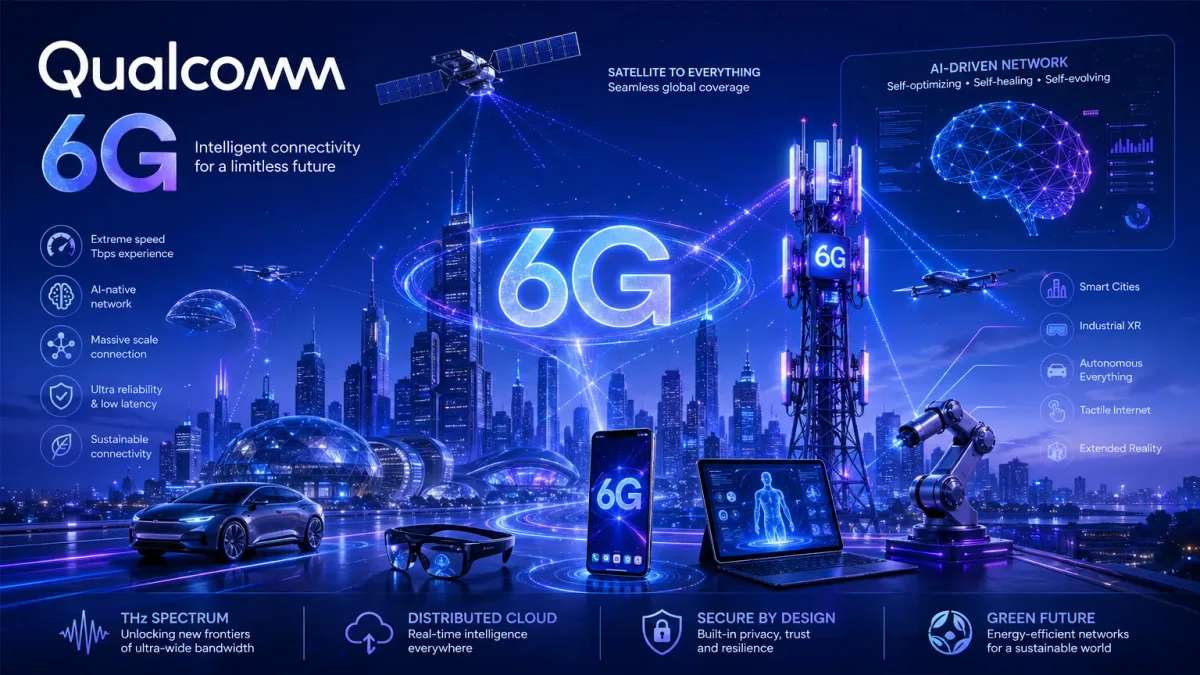
The telecom industry stands at a defining crossroads. As 6G development accelerates into 3GPP Release 20, unresolved questions around AI integration and interoperability threaten to splinter the next generation of wireless into competing standards — and the decisions made today will shape global connectivity for decades.
The world is counting down to 6G, but the foundation beneath that ambition remains unfinished. Standards bodies, governments, and industry leaders are now sounding alarms that without a unified technical rulebook — especially for AI compatibility and cross-vendor interoperability — the industry risks repeating the fragmentation that plagued 3G. For every stakeholder from Delhi to Deutsche Telekom, this is the decade that defines whether 6G becomes a true global platform or a patchwork of regional silos.
Where 6G Standardisation Stands Right Now
The 6G standardisation process has entered a critical new phase, with the scope of 3GPP Release 20 now outlined and official technical study projects underway that focus on foundational wireless technology areas crucial for 6G Work Items expected in Release 21. Release 20 has already begun and is expected to reach completion by June 2027.
The major bodies driving this groundwork include 3GPP, ITU, IEEE, ETSI, and the O-RAN Alliance, all working under the ITU 2030 horizon. The rough calendar target for 6G deployment remains 2030, with specifications solidifying across 3GPP Releases 19 through 21.
However, the clock is tight. Technical studies that kick-start the 6G standardisation process only got underway in August–September 2025, and it will take more than a year of peer analysis by major tech vendors before the main standards bodies can decide on key issues such as spectrum requirements, air interface protocols, and handover to other standards — including 4G, 5G, Wi-Fi, Zigbee, and Bluetooth.
Also Read : Deutsche Telekom Pays Record €1 Dividend Today — But the Stock Drop Signals a Battle Ahead
The Geopolitical Wild Card
Not every delay is technical. Andrew Kitson, Director of Technology at BMI, warns that the process may be far more difficult this time around, as contributions made by mainland Chinese technology companies will require exceptionally fine scrutiny given current geopolitical tensions.
BMI does not expect the 6G standard to be formalised before late 2027 or early 2028, and it may well be that — as was the case with 3G — several different 6G standards will emerge.
Why AI Integration Could Make or Break 6G
Thomas van Briel, Chief Network Architect at Group Technology of Deutsche Telekom, states that to enable native and large-scale adoption of AI within 6G, a coherent set of standards is required — particularly for interfaces, data models, and data translation.
Such standardisation is critical to ensuring that AI can be seamlessly integrated, interoperable across vendors and domains, and effectively leveraged for intelligent, autonomous, and adaptive 6G network operations, Briel argues.
This is a sharp departure from how 5G handled intelligence. Unlike 5G, where AI is largely applied to network optimisation and operations, 6G is expected to embed AI more deeply into network design itself — shaping how radio resources are allocated, how networks self-optimise, and how services are orchestrated end-to-end, notes Pinkesh Kotecha, MD and Chairman of Ishan Technologies.
Also Read : Pakistan Bets Rs. 4.8 Billion on Semiconductor Engineers — Here Is What It Means for 7,200 Young Professionals
What 5G Got Wrong That 6G Must Fix
Industry concerns around 5G specifications have highlighted gaps related to rigidity, integration and interoperability challenges, roaming struggles, multi-vendor compatibility issues, and the problem of operating in siloes. Too many prescriptions for architecture — rather than a focus on functional requirements — also made 5G standards clunky and hindered deployments.
The O-RAN community reflects this mixed reality. In the next Generation Research Group (nGRG), a task force within the O-RAN Alliance, 86% of participants believe there will be a mix of O-RAN components alongside 3GPP and legacy deployments, while only 14% believe the 6G mobile network will be exclusively 3GPP-based.
India Places a Big Bet on 6G
India is highly ambitious about this leap. The Bharat 6G Mission envisions the sector contributing nearly USD 1.2 trillion to the national GDP by 2035, with the country targeting 10% of global 6G patents. A joint declaration on 6G Principles was also released on 10 October 2025.
Kotecha points out that India’s approach, as outlined in the Bharat 6G Vision, is to actively shape global standards so that future networks remain interoperable across vendors, secure by design, and economically scalable.
The goal is not to create parallel or localised standards, but to influence global frameworks while building domestic R&D depth, developing home-grown intellectual property, and preparing the ecosystem for large-scale deployment.
Kotecha also raises a structural warning for markets like India. Without alignment between spectrum policy, standards, and local engineering capability, 6G networks risk becoming fragmented and difficult to scale beyond dense urban centres — limiting their impact in a country where affordability and nationwide reach matter as much as peak performance.
The Standardisation-or-Stagnation Dilemma
Sanjay Sehgal, CEO and MD of TP-Link India, stresses that with the world moving towards smart connectivity, IoT, and AI/ML-based controls, 6G standardisation should be implemented sooner rather than later.
He adds that the total roll-out will take time given standardisation deliberations, government concerns, and the need to refresh both software and hardware — but that this process will ultimately lead to more innovation in the fields of IT and telecom.
AEO: Frequently Asked Questions on 6G Standards
Q1: When will 6G standards be finalised?
The 6G standard is not expected to be formalised before late 2027 or early 2028. 3GPP Release 20 — a key step toward 6G — began recently and targets completion by June 2027. Full 6G deployment remains on track for around 2030, though geopolitical tensions and unresolved technical debates could push timelines further.
Q2: What is the biggest risk in 6G development right now?
The biggest risk is fragmentation. Without a unified global standard, the 6G industry could split into competing regional standards — just as 3G did. Competing approaches to AI integration and interoperability across vendors are the two fault lines most likely to cause a fracture.
Q3: Why does AI integration matter so much for 6G networks?
Unlike 5G, which uses AI mainly for network optimisation after the fact, 6G embeds AI directly into network design itself. This means AI standards must cover interfaces, data models, and data translation at the architecture level — or the entire promise of autonomous, adaptive 6G networks falls apart.
Q4: What is India targeting with its Bharat 6G Mission?
India targets a contribution of nearly USD 1.2 trillion to its national GDP by 2035 through 6G, and aims to hold 10% of global 6G patents. The strategy focuses on shaping international standards rather than building separate local ones — prioritising domestic R&D, home-grown intellectual property, and a deployment-ready ecosystem.