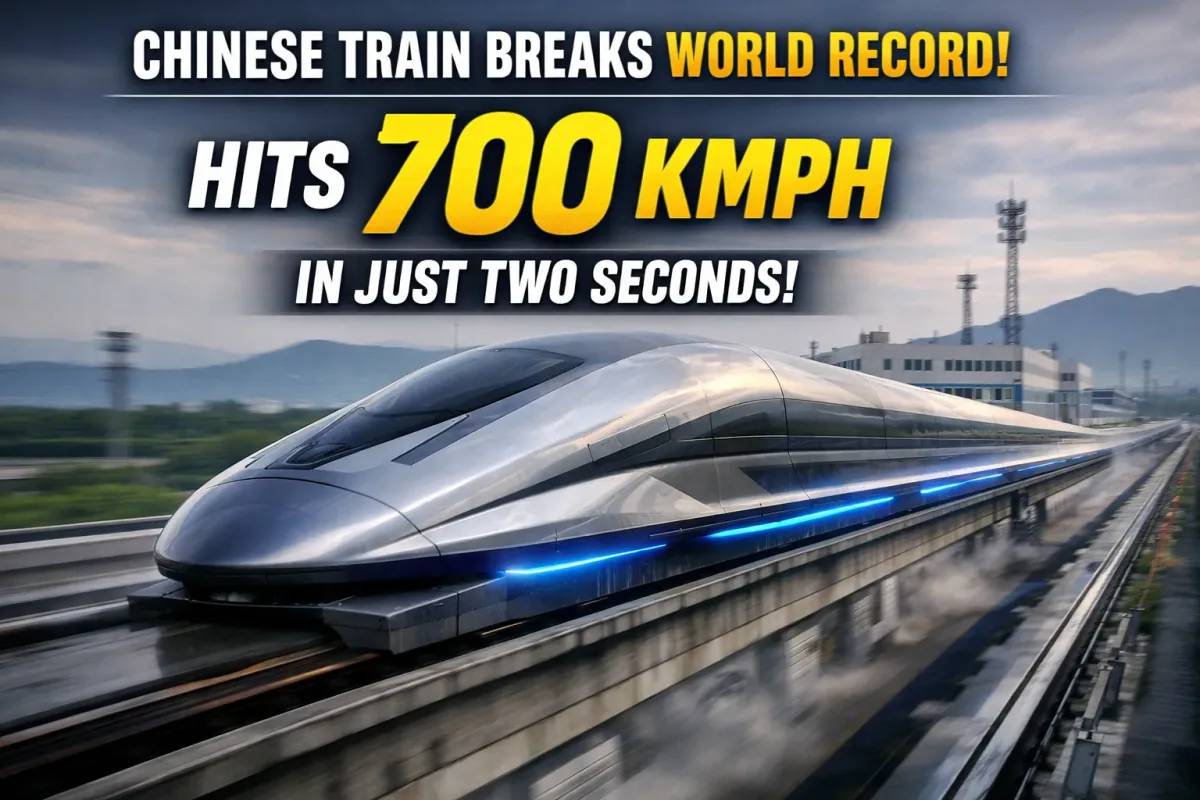
China’s latest maglev breakthrough doesn’t just break records—it rewrites the rules of what’s possible in high-speed transport. Researchers have accelerated a vehicle to 700 km/h in under two seconds, leaving the world stunned.
This isn’t your typical train upgrade. Scientists at China’s National University of Defence Technology achieved what seemed impossible: launching a tonne-class vehicle from zero to 435 mph faster than most cars reach highway speeds. The implications stretch far beyond passenger rail.
The Record That Left Scientists Speechless
On a 400-meter test track, Chinese researchers demonstrated extreme acceleration that sets a new global standard. The superconducting electric maglev system propelled the vehicle with force intense enough to leave a trail of mist in its wake.
State broadcaster CCTV captured the moment. The footage shows a chassis-like vehicle exploding across the magnetic levitation track before stopping with equal precision at the end of the line.
This achievement marks China’s entry into the elite tier of ultra-high-speed maglev technology. No other nation has demonstrated this level of acceleration control at such extreme speeds.
What Makes This Technology Revolutionary
The breakthrough solves multiple technical challenges that stumped engineers for years. The system masters ultra-high-speed electromagnetic propulsion while maintaining perfect stability.
Electric suspension guidance keeps the vehicle floating smoothly. Transient high-power energy storage handles the massive power demands. High-field superconducting magnets generate the forces needed for such rapid acceleration.
These components work together seamlessly. The result transforms theoretical concepts into proven technology.
Beyond Trains: Military and Space Applications
This same acceleration technology opens doors scientists barely imagined. The force that launched the test vehicle could revolutionize aerospace launches.
Electromagnetic acceleration provides new methods for rocket launch assistance. Engineers can now test concepts that seemed decades away from reality.
Military applications remain classified, but the possibilities captivate defense analysts worldwide. Rapid deployment systems could reshape strategic planning.
The Hyperloop Dream Moves Closer
China’s hyperloop ambitions gain serious momentum with this breakthrough. Vacuum-sealed tubes connecting cities in minutes transform from science fiction to engineering challenge.
The acceleration capability proves the core technology works. Now engineers can focus on scaling up and building full-length routes.
Cities hundreds of miles apart could connect in under an hour. Daily commutes might span entire regions instead of neighborhoods.
How Fast Is 700 km/h Really?
Consider commercial aircraft. Most passenger jets cruise around 800-900 km/h at altitude. This maglev system reaches nearly jet speeds at ground level—in two seconds.
Formula One cars accelerate from 0-100 km/h in roughly 2.6 seconds. This train covers seven times that distance in the same timeframe.
The physics involved push materials and engineering to their absolute limits.
High-Power Control: The Hidden Achievement
Speed grabs headlines, but control determines success. Stopping a vehicle traveling 700 km/h requires precision that matches the acceleration.
The system brings the vehicle to a complete stop safely within the 400-meter track length. This demonstrates mastery over both acceleration and deceleration forces.
Engineers solved the energy management puzzle. The system stores, releases, and recaptures massive amounts of power seamlessly.
Global Competition Heats Up
China’s achievement pressures other nations pursuing similar technology. Japan, South Korea, and European countries all invest heavily in maglev research.
The United States explores hyperloop concepts through private ventures. Yet China’s government-backed research demonstrates what coordinated national efforts can accomplish.
This test proves China doesn’t just compete in high-speed rail—they lead it.
What Happens Next?
The National University of Defence Technology team focuses on scaling the technology now. Moving from a 400-meter test track to commercial-length routes presents new challenges.
Power supply infrastructure must handle sustained operation. Track construction requires precision at unprecedented scales. Safety systems need development for passenger service.
Yet the core technology works. The hardest questions found their answers on that test track.
The Future Arrives Early
Transport experts predicted these capabilities might arrive by 2030 or beyond. China delivered five years ahead of schedule.
Students studying engineering today will work on projects using this technology tomorrow. Urban planning departments must rethink city spacing and development.
The world watches closely as China transforms laboratory success into real-world application.
Frequently Asked Questions
How fast did China’s new maglev train actually go?
China’s maglev train reached 700 kilometers per hour (435 miles per hour) in less than two seconds. That’s nearly as fast as a commercial jet flies at cruising altitude, except this happened on the ground. The National University of Defence Technology achieved this record on a 400-meter test track, making it the world’s fastest superconducting electric maglev system to date. To put this in perspective, the train accelerates seven times faster than a Formula One race car.
What makes China’s maglev train different from regular high-speed trains?
China’s maglev train uses magnetic levitation technology instead of wheels on rails. Superconducting magnets lift the vehicle completely off the track, eliminating friction and allowing for extreme speeds. Regular high-speed trains still touch the tracks, which limits their maximum speed and acceleration. This new system also features ultra-high-speed electromagnetic propulsion and transient high-power energy storage that enables the lightning-fast acceleration. The technology solves problems that kept other countries from achieving these speeds safely.
Will China build passenger trains that travel 700 km/h?
China aims to use this technology for future hyperloop transport systems with vacuum-sealed tubes connecting cities. The current test proved the core acceleration technology works reliably and safely. Engineers now focus on scaling up from the 400-meter test track to commercial-length routes that can carry passengers. This breakthrough moves China closer to building the world’s first operational hyperloop system, though full passenger service still requires additional development time for safety systems and infrastructure.
Can other countries build trains as fast as China’s maglev?
Several countries actively research similar maglev technology, including Japan, South Korea, and European nations. The United States explores hyperloop concepts through private companies. However, China’s government-backed research program just demonstrated capabilities that other nations haven’t matched yet. The technology exists, but replicating China’s success requires massive investment in research facilities, test tracks, and specialized engineering teams. China currently leads the global race in ultra-high-speed maglev development.
Conclusion: A New Era of Speed
China’s record-breaking maglev test represents more than engineering excellence. It signals a fundamental shift in what humanity can achieve in transport technology.
The 700 km/h barrier fell in spectacular fashion. Now the race begins to see which nation builds the first commercial hyperloop system. China just proved the technology works—they’re betting they’ll be first to make it practical.
The mist trail left on that test track marks more than a vehicle’s path. It traces the route toward a future where distance shrinks and speed redefines possible.