SK Telecom and Ericsson Lock In a 6G and AI-RAN Alliance That Could Redraw the Global Telecom Map
South Korea is doubling down on next-generation connectivity. SK Telecom (NYSE: SKM) and Ericsson (NASDAQ: ERIC) announced the signing of a Memorandum of Understanding to strengthen their collaboration on mobile network technologies spanning 5G to future 6G. The deal sets the stage for one of the most ambitious joint telecom R&D programs in Asia.
Networks today struggle with rising energy costs, growing traffic complexity, and the urgent pressure to deliver 6G-ready infrastructure. This partnership tackles all three fronts head-on — and gives enterprises, operators, and governments a clearer picture of where global connectivity is heading next.
A Long-Term Commitment, Not a Short-Term Handshake
SK Telecom and Ericsson agreed to establish a long-term framework for joint R&D and trials running until 2 March 2031. That six-year runway signals serious intent from both sides.
The MoU focuses on joint exploration and validation of cutting-edge network technologies, with the aim of enabling practical deployment of innovations in the 5G era while laying the foundation for long-term 6G research and standardization.
This is not a pilot project. Both companies frame the agreement as a structural commitment to shape the next generation of global mobile networks from the ground up.
Also Read : Telecom Stocks Beat the Market in 2026 — and Analysts Say They Still Look Cheap
What the Two Companies Will Actually Build Together
AI-Powered Radio Access Networks
Under the agreement, the two companies will develop AI-powered Radio Access Networks to enhance performance, security, and energy efficiency by autonomously learning, predicting, and optimizing channel conditions, as well as managing resources more efficiently.
In AI-RAN specifically, the companies aim to develop networks that can learn and predict channel conditions in real time to optimize performance, security, and energy efficiency. This moves networks from reactive systems to self-managing infrastructure — a fundamental shift in how mobile networks operate.
Open and Autonomous Networks
For open and autonomous networks, the two companies will explore automation technologies to improve operational efficiency in multivendor environments. The goal is to reduce the friction and cost of running complex, multi-supplier network deployments — a persistent headache for operators globally.
Zero-Trust Security
End-to-end security built on zero trust architecture and continuous monitoring will provide stronger protection and real-time threat response across both 5G Advanced and 6G environments. The partnership includes the adoption of a zero-trust security framework to enhance real-time threat detection and response.
6G Standardization and Future Technologies
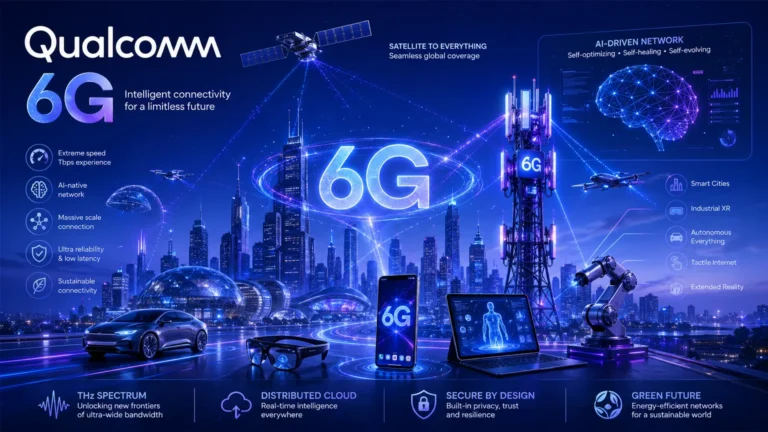
6G standardization efforts will cover future technologies such as spectrum strategy, extreme MIMO evolution, energy efficiency, and Integrated Sensing and Communication (ISAC). These areas represent the technical building blocks that will define what 6G actually delivers when it arrives commercially.
Also Read : Broadcom Stock Could Surge 91% — Here Is Why Analysts Say Buy Before It Hits $3 Trillion
The Leaders Behind the Vision
Yu Takki, Head of Network Technology Office at SK Telecom, said: “Our collaboration with Ericsson will be a core engine propelling the evolution of AI-powered networks, paving the way toward 6G. Through research focused on global standardization and real-world validation, we aim to secure world-class technological leadership in AI-powered network evolution and 6G.”
Marton Lerner, Head of Networks Strategy and Product Management at Ericsson, said the partnership will accelerate AI-powered RAN, 5G monetization, open autonomous networks, and zero-trust security, while laying the groundwork for AI-native 6G. Together, the two companies will move rapidly from standards and trials to commercial solutions that boost performance, energy efficiency, and security — strengthening South Korea’s leadership in next-generation connectivity.
Why South Korea Stands to Gain the Most
The initiative is expected to reinforce South Korea’s position as a global leader in next-generation connectivity while accelerating the industry’s transition toward 6G-ready networks.
South Korea already leads the world in 5G penetration. This MoU positions it to repeat that success in the 6G era — this time with a stronger foundation in autonomous, energy-efficient, and security-hardened infrastructure built from the radio layer up.
Through joint research, SKT and Ericsson aim to strengthen their global collaboration framework and secure a leading position in the 6G technology ecosystem, driving the evolution of next-generation AI-powered networks.
From Standards to Commercial Reality
What separates this deal from previous industry announcements is the emphasis on real-world validation, not just research papers. The agreement focuses on joint exploration and validation of network technologies including AI-powered RAN, open and autonomous networks, end-to-end security, 6G standardisation, and integrated sensing and communication.
The path from laboratory to live network is where most telecom innovation stalls. Both SKT and Ericsson explicitly commit to closing that gap — building commercial solutions that operators can actually deploy before the decade ends.
Questions and Answers
What did SK Telecom and Ericsson agree to in their 2026 MoU?
SK Telecom and Ericsson signed an MoU on 19 March 2026 to run joint R&D and network trials through 2031. The deal covers AI-powered RAN, open and autonomous networks, zero-trust security, 5G advancement, and 6G standardization. Both companies aim to move from research directly into commercial deployment.
What is AI-RAN and why does it matter for 6G?
AI-RAN stands for AI-powered Radio Access Network. It lets networks autonomously learn, predict, and optimize channel conditions in real time. SK Telecom and Ericsson are developing AI-RAN because it dramatically improves spectrum efficiency, cuts energy consumption, and builds the intelligent foundation that 6G requires.
How long does the SK Telecom and Ericsson partnership last?
The MoU runs until 2 March 2031. That six-year commitment covers joint exploration, validation, and potential commercialization of next-generation network technologies across both 5G and 6G domains.
How does zero-trust security fit into the SKT and Ericsson 6G roadmap?
SK Telecom and Ericsson embed zero-trust security into the core of their collaboration. The framework applies continuous monitoring and real-time threat detection across 5G Advanced and 6G environments. It removes the assumption that any user or device inside a network is automatically safe.
References
- SK Telecom Official Newsroom: https://news.sktelecom.com/en/2854
- The Korea Herald: https://www.koreaherald.com/article/10698159
- Mobile World Live: https://www.mobileworldlive.com/ericsson/skt-ericsson-partner-on-6g-softbank-claims-efficiency-gains
- TelecomLead: https://telecomlead.com/6g/sk-telecom-and-ericsson-accelerate-6g-innovation-with-ai-powered-network-collaboration-125175
- TechAfrica News: https://techafricanews.com/2026/03/19/ericsson-and-sk-telecom-deepen-partnership-on-ai-powered-5g-and-future-6g-networks/
- Telecoms.com (original source): https://www.telecoms.com/5g-6g/ericsson-and-sk-telecom-team-up-for-ai-ran-and-6g-r-d